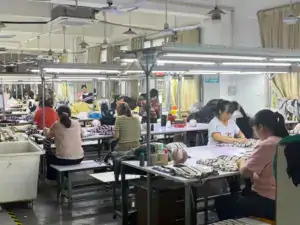
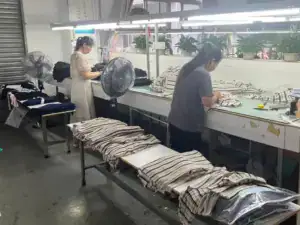
Where the unit cost difference comes from
Bulk wins on unit cost for one reason: setup is spread across more pieces. Pattern making, grading, dye lots, machine changeover and sampling are paid once regardless of quantity. At 50 pcs per style those costs sit on fewer units, so the per-piece number is higher, and that is the honest price of proving a design. What bulk buys with that discount is exposure: inventory, cash tied up, and a bet that the fit and the market were both right.
| Dimension | Trial at 50 pcs | Bulk run |
|---|---|---|
| Unit cost | Higher, setup on fewer units | Lower, setup amortised |
| Cash exposure | 20% deposit on a small total | Deposit on a large total |
| Inventory risk | Minimal, sells through or not | Full, discounting if wrong |
| Design risk | Contained, fit proven cheaply | Carried from trial spec |
| Reorder speed | Spec sheet already exists | Immediate on approval |
The phased path beats the argument
The program that works in practice: trial the style at 50 pcs per style with sizes mixed, read the sell-through, then run bulk on the same spec sheet and costing. Nothing is re-quoted because the pattern, grading and sampling are already paid for. The buyer’s second order skips the setup conversation, and the factory prices production only. Both sides carry less risk than a first-order bulk bet, and the data that decides the bulk quantity is real instead of guessed. Buyers describe this partner in different words. Some search for a clothing manufacturer with low moq, others for clothing manufacturers with low moq, and many shorten it to clothing manufacturers low moq. The phrasing varies, but the need is the same: a small, low-risk first run before any bulk commitment.
Lead time behaves the same way. Sampling runs 7 to 10 days with fabric in house; bulk runs by category from PP approval and fabric confirmation, 45 to 70 days for knit, 45 to 90 for woven and 30 to 55 for sweater programs.
Frequently asked questions
How much cheaper is bulk per piece?
It depends on how much setup the style carries. Print placement, trims and dye lots dominate the trial’s unit cost, so a simple style sees a small gap and a heavily embellished style sees a large one. Both quotes are shown on one sheet so the comparison is real, not narrative.
Can the trial and bulk use different fabrics?
They can, but then the trial did not prove what you are about to order. Fabric changes after approval restart the fit conversation, so the switch is priced and re-sampled rather than assumed.
What sells-through number justifies bulk?
The number that matters is reorder speed, not a fixed percentage. A trial that sells through fast at full price is a stronger bulk signal than one that sold through on discount, whatever the percentage says.