
Custom Clothing Manufacturers in China
Ningbo · knit & woven OEM / ODM / private label · Low MOQ 50 pcs per style · samples in 7–10 days when fabric is available · knitwear 45–70 days, woven 45–90 days, sweaters 30–55 days





Ningbo · knit & woven OEM / ODM / private label · MOQ 50 pcs per style · samples in 7–10 days when fabric is available · knitwear 45–70 days, woven 45–90 days, sweaters 30–55 days
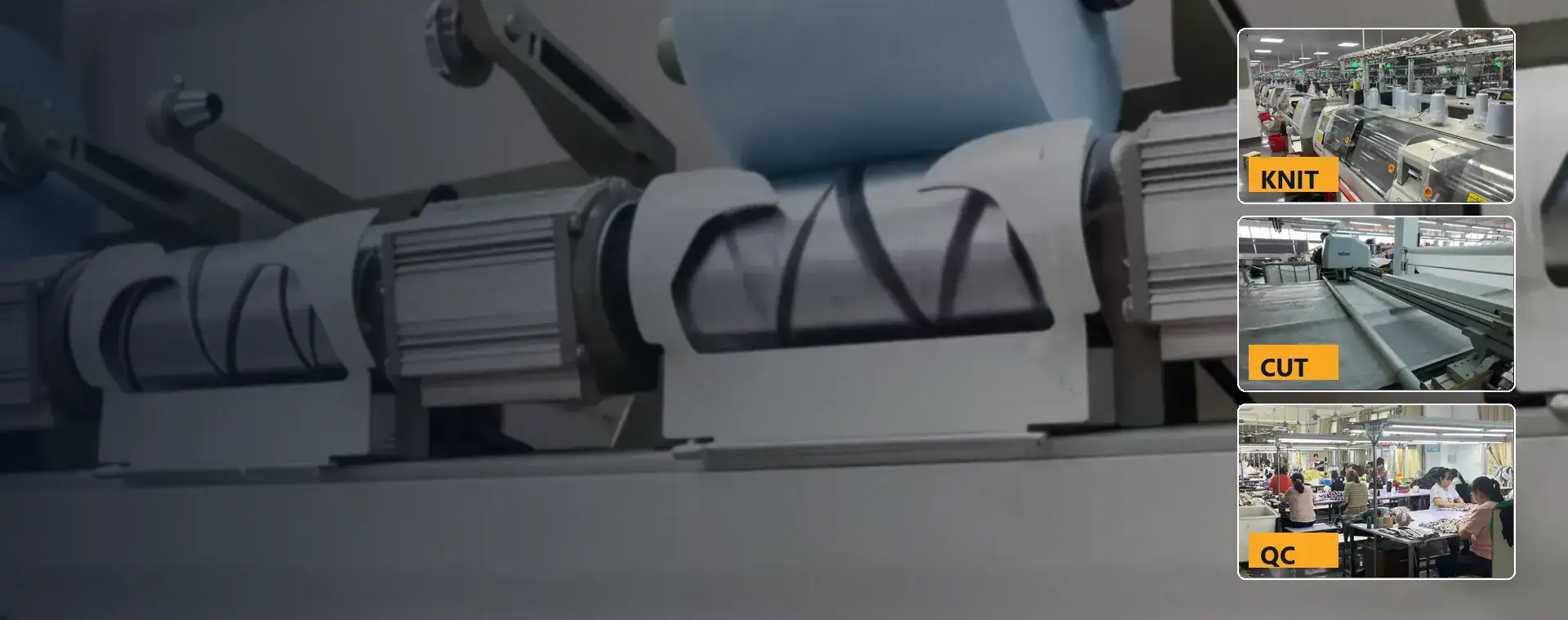
Choosing between custom clothing manufacturers in China usually comes down to three questions. Does the factory run its own sewing line? Does the MOQ fit your first drop? Can it hold a shade match from sample to bulk? We’re Ningbo United Fish, trading as nbfish, a women’s knit and woven apparel factory running since 2005 with 100% of our processes in-house. This page is for buyers shortlisting factories right now. It covers where the money goes, the lead times we quote, the checks we’d want run on us, and what we make.
What a custom clothing manufacturer in China actually does
A custom clothing manufacturer makes to your specification instead of selling stock from a catalogue. There are three models, and the one you pick sets your MOQ, your sampling time and how much of the design you own:
- OEM: you supply a complete tech pack and we build exactly that, fabric, trims, construction and grading. Highest control, the longest development path, and the design is yours alone.
- ODM: you start from a style we’ve already developed and change fabric, colour, print or trims. Sampling is shorter because the base pattern exists.
- Private label: our developed body carries your labels, hangtags and packaging. Fastest route, usually the lowest MOQ, because part of the development is already paid for.
Most brands climb that ladder rather than pick one forever: private label to test demand, ODM to differentiate, OEM once volume and design ownership matter. The label matters less than people think. What separates factories is simpler: whether the line that sews your bulk is the line that sewed your sample, and whether the people answering your email are the ones running the floor.
Why brands still source custom clothing from China
China’s edge in 2026 isn’t the cheapest unit price anymore. It’s density. Yarn, fabric, dyeing, printing, washing, hardware and trims all sit within a short radius, so a comment on Monday’s sample can come back corrected in the same week. That’s what makes complex work realistic at small volumes: developed yarns, hand-linked knitwear, embellishment, mixed-media garments. It’s also why factories here will still take 50 pcs when mills elsewhere want 3,000.
Two honest caveats. Lead times are longer than they used to be, and US-bound goods carry real tariff exposure. On basic, high-volume knit programmes the unit-cost gap has narrowed too. If your line is 20,000 pcs of one basic body, you’re in a different sourcing conversation from the one on this page.
Where the money goes
Ask any factory to break a quote into these lines. One number that hides them is how a cheap quote turns into an expensive order.
| Cost line | What sets the number | What to ask |
|---|---|---|
| Fabric | Yarn count / GSM, finish, mill lot size, whether it is in stock | “Is this fabric in stock, and what is the mill minimum?” |
| Trims & hardware | Buttons, zips, labels, hangtags, each with its own supplier MOQ | “Which trims have a supplier minimum above my order?” |
| Cut, make, trim (CMT) | Number of operations, stitch count, line set-up | “How many operations is this style, and does a small run carry a set-up fee?” |
| Development & sampling | Proto, SMS, PP, size set, and how many rounds you need | “Is the sampling fee credited back against bulk?” |
| Washing & finishing | Enzyme, stone, softener, pressing, special packing | “Is the wash quoted per piece or per batch?” |
| Testing & compliance | Market (REACH, azo-free, CPSIA), lab used, number of tests | “Which test reports come with the shipment?” |
| Freight & duty | Mode, season, destination, tariff classification | “Is this FOB, and who books the freight?” |
| FOB unit price range | Confirm with your Dedicated Customer Service | |
Lead time reality check
The long pole is almost always fabric or yarn, not sewing. Our published numbers:
| Stage | Our standard | Note |
|---|---|---|
| Sampling (proto / SMS / PP) | 7–10 days | When fabric is available. Development or custom yarn adds time. |
| Bulk, knitwear | 45–70 days | After PP approval and fabric / yarn confirmation. |
| Bulk, woven | 45–90 days | After PP approval and fabric / yarn confirmation. |
| Bulk, sweaters | 30–55 days | After PP approval and fabric confirmation. |
| Sea freight to EU / US | Real time confirmation with freight companies | Ask for the current transit window at quote stage; it moves with the season. |
We quote lead time per order rather than one fixed number. A 50-piece trial in stock fabric and a 5,000-piece run in a custom yarn don’t share a calendar.
MOQ: why 50 pcs per style is the usual floor
Our published MOQ is 50 pcs per style; on seamless knit programmes it’s quoted per size as well as per style. The floor is usually set by the material rather than the sewing floor. A dye lot, a yarn cone order or a trim supplier’s minimum will push it up long before the line does. Use a fabric we already hold and the number drops toward the garment minimum, which is why the fastest first orders are built on in-stock material.
How to vet a clothing manufacturer in China
Run these checks on us and on anyone else you’re comparing. They’re ordered by how often they catch a real problem.
Seven checks before you pay a deposit
- The business licence scope matches what they claim to make. A licence that covers trading but not manufacturing tells you who will actually sew your order.
- The sewing floor is theirs. Ask for a live video walk during working hours. Not a showroom tour, not a stock video.
- Bulk is gated behind a signed PP sample. If a factory will start bulk on a photo or a “similar” sample, you have no reference to reject against.
- The AQL standard is written down. Acceptance criteria, in-line checks and a 100% final inspection should be stated, not implied.
- Fabric composition and origin are documented. Ask for the composition statement and, where your market requires it, the test report.
- The quote is itemised. Unit price, sampling, testing and freight as separate lines.
- A reorder file exists. Pattern, markers, approved fabric and QC standard kept on file is what makes the second batch match the first.
Red flags we see buyers fall for
- A licence or a “factory” address that turns out to be an office, with production moved to an unnamed workshop.
- A sample room that isn’t the bulk line: beautiful samples, then a bulk run made somewhere looser.
- An unusually low MOQ used to win the enquiry, followed by a price revision once the tech pack is in.
- A single-line quote that gets vague the moment you ask what’s inside it.
- An audit visit that only ever shows the showroom, and never a working floor on a weekday.
Knit vs woven: which line fits your collection
Knit and woven are different makes. Knit goes from yarn to garment on machines; woven is cut-and-sew from rolled cloth. We across our two Ningbo plants, so one production manager owns your whole order.
Knitwear: gauge, yarn and linking
Our sweater line runs 7G to 18G fully automatic computerized knitting machines, with linking machines and linking pull machines. The linking pull machine is what removes the loose or burst seam risk at the shoulder and armhole. Panels go through light-checking tables, then industrial washing and drying, then steam pressing. For premium programmes we develop yarns to an anti-pilling performance of grade 3–4. Coarser gauges (7G–9G) suit chunky autumn knitwear; 12G–14G covers most fine-gauge sweaters and cardigans; 16G–18G is for lightweight layers. Gauge choice drives both hand-feel and cost, so it’s worth deciding early.
Woven: cutting, fusing and tailoring
Rolled cloth is inspected on the 4-point system before it is laid, cut by marker on high-speed automatic cutting beds, and laser-cut where the design needs precision. Fabric pre-shrinking machines control dimensional stability and torquing (skewing), which is what keeps a woven garment from twisting after the customer washes it. Collars and pocket openings are made on dedicated template machines; bundles move on an intelligent hanging line; every piece passes needle detection before packing. Tailored styles get fusing, lining and shoulder construction built to your tech pack.
Product categories we manufacture
| Category | What we make in it | Detail |
|---|---|---|
| Knit Tops | Tees, camis, long sleeves in cotton, viscose and blends | Knit Tops Manufacturer |
| Cardigans & Pullovers | Knit sweaters and cardigans, 7G–18G, linked and washed | Cardigan Manufacturer |
| Dresses | Sundress, shirt dress, midi and occasion styles, woven and knit | Dress Manufacturer |
| Skirts | A-line, pleated, pencil and bias-cut, woven and knit | Skirt Manufacturer |
| Shirts & Blouses | Poplin, satin and viscose shirting and shirt-dresses | Blouse Manufacturer |
| Trousers & Shorts | Wide-leg, tapered, cargo, tailored pants and shorts | Trousers Manufacturer |
| Jackets & Coats | Blouson, bomber, quilted and utility outerwear | Jacket Manufacturer |
| Blazers | Single- and double-breasted tailoring, lining and fusing options | Blazer Manufacturer |
| Boucle Knitwear | Looped-yarn jackets, coats and dresses, stabilised seams, full lining | Boucle Knitwear Manufacturer |
| Faux Leather & Suede | Jackets, skirts and pants, cutting, bonding, hardware | Faux Leather Manufacturer |
| Crochet & Lace | Machine-crochet tops, lace blouses, eyelet embroidery | Crochet Manufacturer |
| Sequin & Embellished | All-over sequin dresses, tops and skirts, heat-set crystal, hand beading | Sequin Manufacturer |
Fabrics, yarns and trims we work with
Cotton, viscose, modal, polyester and their blends, plus boucle, faux leather and suede, crochet and lace, and embellished bases. On the responsible-sourcing side we work with EcoVero™ viscose, GRS-certified recycled materials and BCI cotton. These come up most often in European buyer briefs, and they need to be booked at the mill, not added later. Our in-house laboratory is run to ISO standards and calibrated for AATCC methods: rubbing fastness, ICI pilling box, perspiration, shrinkage and light-box colour assessment. Bulk shade is matched to the approved sample on an electronic spectrophotometer, with Delta E monitored so a reorder lands in the same place as the first drop.
MOQ, sampling and payment terms
| Item | Our standard | Note |
|---|---|---|
| MOQ | 50 pcs per style | 50 pcs per style per size on seamless knit programmes. |
| Sampling | 7–10 days | Proto, SMS where needed, PP as the bulk reference, size set to lock grading. |
| Sampling fee | Free of charge | State whether it is credited against bulk. Buyers ask this first. |
| Bulk, knitwear | 45–70 days | After PP approval and fabric / yarn confirmation. |
| Bulk, woven | 45–90 days | After PP approval and fabric / yarn confirmation. |
| Bulk, sweaters | 30–55 days | After PP approval and fabric confirmation. |
| Payment | 20% deposit, 80% before shipment | T/T or L/C. |
| Quote turnaround | 24 hours | A firm number with a tech pack; a range without one. |
From tech pack to shipment: our seven steps
- Inquiry and tech pack review. You send a pack or a brief; we come back on feasibility.
- Fabric and yarn sourcing. We confirm material, lot availability and any mill minimum.
- Quote, MOQ and lead time. Itemised, so you can see what you are buying.
- Sampling. Proto, SMS if the style needs it, then the PP sample.
- PP approval and size set. Bulk does not start until you have signed the PP.
- Bulk production. In-line inspection, then 100% final inspection against the PP.
- Packing and shipment. Inspection report, packing list and shipping marks verified before the container closes.
Quality control: what we check
Quality is a sequence, not a final inspection. Fabric passes the 4-point system before cutting. In-line inspectors sit on the line. Every finished garment goes through a 100% final inspection, combined with AQL sampling for release. Bulk shade is measured against the approved sample on a spectrophotometer, and needle detection is mandatory on every piece. The PP sample is the contract: a piece that doesn’t match it is reworked or rejected before it ships. Because the pattern, markers, approved fabric and QC standard stay on file, a reorder starts from the same shape as the first batch.
Certifications and compliance
We hold GRS (Global Recycled Standard), BCI (Better Cotton Initiative) and BSCI (Business Social Compliance Initiative) certification, and we document fabric composition and origin per shipment. For export we confirm restricted-substance requirements (REACH, azo-free dyes) by destination market. Three checks whenever you verify any certificate, ours included: the document name and number, the validity window, and the scope, meaning which products and which sites it actually covers. A certificate with a date and a scope tells you more than a logo on a website.
China vs other sourcing countries
No unit prices in this table; they move too fast to print honestly. Use it to shortlist, then get quotes.
| Origin | MOQ flexibility | Lead time | Strongest at | Fit |
|---|---|---|---|---|
| China | High, 50 pcs programmes are normal | Medium | Complex make, developed yarns, embellishment, fast sampling | Small-batch trials and technically difficult styles |
| Vietnam | Medium | Medium | Sportswear, outerwear, woven basics | Mid-volume programmes |
| Bangladesh | Low, built for volume | Longer | Basic knitwear at scale | Large runs of simple bodies |
| Turkey | Medium | Short to Europe | Quick response, woven | European replenishment |
| Portugal | Medium, higher unit cost | Short | Premium small-batch | European premium lines |
| India | Medium | Medium to long | Handwork, embroidery, cotton woven | Embellished and cotton programmes |
Frequently asked questions
How do I find a reliable clothing manufacturer in China?
Check three things before anything else: the business licence scope, whether the sewing floor is theirs (ask for a live video walk during working hours), and whether bulk is gated behind a signed pre-production sample. Then ask what happens on a reorder. A factory that keeps pattern, markers and approved fabric on file can repeat a batch; one that can’t will re-develop it.
What is a realistic MOQ for a first order?
50 pcs per style is the common floor for export factories, and it’s ours. The real minimum is usually set by the fabric or yarn mill rather than the sewing line, so choosing an in-stock material is the cheapest way to lower it. Be wary of any factory quoting 50 pcs on a custom fabric. The number usually moves once the tech pack is in.
How long does production take from tech pack to shipment?
Sampling takes 7–10 days when fabric is available. Bulk runs knitwear 45–70 days, woven 45–90 days, sweaters 30–55 days, starting after PP approval and material confirmation. The longest stage is nearly always fabric or yarn, not sewing, so pin the material down before you promise a delivery date.
Can I visit the factory, or audit remotely?
Yes to both. We host buyer visits, and when travel isn’t practical we run a live video walk of the floor during working hours, on the line that would run your order. Remote audits are normal now. A factory that only offers showroom footage is telling you something.
Do you subcontract production?
Core knit and woven production runs on our own lines across two Ningbo plants. Where specialist trims or third-party testing are involved, we tell you which partner and why, before it happens.
Which certifications do you hold, and how do I verify them?
GRS, BCI and BSCI. Ask for the certificate number, the validity window and the scope, and check that the scope covers your product and the site that makes it. We send the current documents on request rather than asking you to trust a logo.