Cut and sew: flexibility first
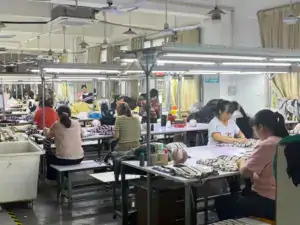
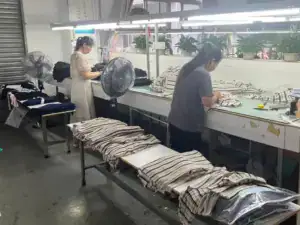
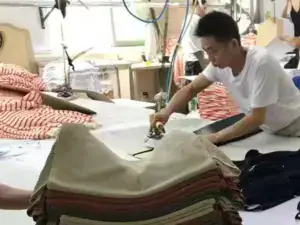
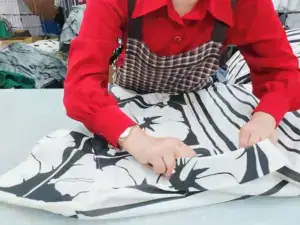
Cut and sew takes circular-knit fabric, lays it up and cuts pattern pieces. Its strength is freedom. Panels can take any shape a pattern asks for, prints and jacquards place anywhere on the panel, and size grading is a pattern exercise rather than a machine change. The cost is the cutting loss between pieces, and edges that need overlocking or binding because the cut edge of a knitted fabric will ladder and curl.
Fully fashioned: efficiency at the panel level
Fully fashioned knitting shapes each panel on the flat beds at our sweater plant, collar and armhole included, so the panels join with the stitches themselves and the cut loss disappears. The joins sit flatter, which reads as a higher-grade garment on the hanger. The trade is design constraint: a shaping change means re-programming the knitting pattern, and the silhouette lives inside what the gauge and the machine can express.
| Dimension | Cut and sew | Fully fashioned |
|---|---|---|
| Design freedom | Any panel shape, any print placement | Constrained by gauge and shaping logic |
| Waste | Cutting loss between pieces | Minimal, panels knitted to shape |
| Edge quality | Cut edges need finishing | Self-finished joins, flatter seams |
| Grading | Pattern-based, fast | Re-programming per size |
| Best for | Fashion-led range, prints, mixed fabrics | Clean sweaters, tailored knits, lower waste |
How the decision shows up in cost and lead time
Fully fashioned programs trade a longer setup for a cleaner per-piece cost at volume, because the knitting time replaces cutting and finishing time. Cut and sew programs start faster and absorb design changes mid-range, which is why fashion-led buyers lean that way. Sweater programs on the flat beds run 30 to 55 days after PP approval and yarn confirmation, and gauge choice is the first decision, not the last, and the trade-offs are set out in our sweater gauge guide.
Most ranges end up using both builds. A brand doing a knit top in printed jersey alongside a fully fashioned cardigan is running one logic per garment, and that is exactly why the two lines sit under one merchandiser rather than one machine park.
Both builds sit inside one custom programme. The custom clothing manufacturers in China page shows how the cut-and-sew lines and the sweater line share one inspection standard, and what each build means for lead time: knit 45–70 days, woven 45–90, flat-machine sweaters 30–55.
Frequently asked questions
Is fully fashioned always the cheaper option at volume?
At steady volume, usually yes, because knitting time replaces cutting and finishing. Below the point where setup is amortised, the calculation flips, which is why we quote both routes on styles that sit near the crossover.
Can one range mix both builds?
Yes, and most do. The knit and woven cut-and-sew line and the flat-bed sweater line are separate plants under one colour standard and one QC process, so a printed top and a fully fashioned cardigan ship from one program with one merchandiser owning both.
Which build suits a 50-piece trial order?
Cut and sew, almost always. Panels cut from circular-knit fabric avoid flat-bed re-programming at small quantities, so the trial proves the design before the shaped-knit investment is made.