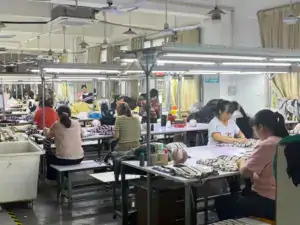
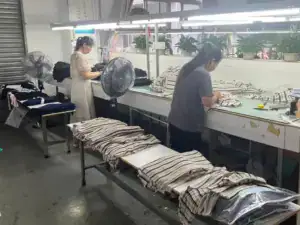
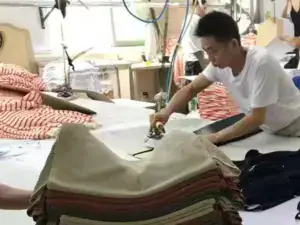
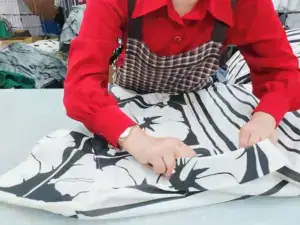
Sequin and bead work is the category where a factory’s discipline shows fastest. A misplaced bead line survives one photo; a base fabric that cannot carry the weight survives one fitting. This page walks through how eveningwear with sequins and beads is actually built at a 50-piece MOQ, and what decides whether the bulk matches the sample. The capacity story behind high-volume sequin programs sits in our high-capacity sequin OEM overview, and the premium workflow is covered in the party-wear manufacturing deep dive.
Sequins, beads and the base fabric underneath
The decoration gets the attention, but the base fabric carries it. Paillette sequins, cup sequins and bugle beads each add weight in different directions, and the base has to hold drape while the weight pulls it down. We start the fabric conversation from the dress silhouette, not from the sequin chart: a bias-cut slip dress and a structured party dress need different ground cloth even under the same embellishment.
| Method | Look | Cost driver | Lead time impact |
|---|---|---|---|
| Machine embroidery with sequin yarn | Even, repeatable all-over coverage | Embroidery machine hours | Predictable, scales well |
| Heat-fix sequin applique | Clean panels, fast coverage | Applique tooling | Fast once the die exists |
| Hand beading on tulle | High-end, irregular sparkle | Hand hours, operator skill | Longest, limited by beaders |
What sampling actually proves
Sampling for beaded styles takes longer than plain knit styles because the placement has to be approved, not just the fit. Expect 10 to 15 days when the base fabric and trims are already in house, more when they are not. The sample round settles three things in order: the silhouette and fit on the body, the bead density and placement against the artwork, and the hand feel after lining. Comment on all three in one round; splitting them across rounds is what turns two rounds into five.
Bead-line QC: where bulk goes wrong
The defects that matter are mechanical. Beads shed when the stitch is too shallow or the thread tension too loose, so we run bead-pull checks on the first pieces of every bundle. Seam slippage appears when the base fabric is light and the seam allowance was carried over from a plain-garment spec. Lining is not optional on beaded dresses: without it, the interlining scratches and the dress returns. These checks run on every piece by default; where a buyer specifies AQL 2.5 sampling inspection, we run to that standard instead and issue the report with the goods.
Bulk runs on the knit side at 45 to 70 days after PP approval and fabric confirmation. Hand-beaded programs sit at the long end of that window and we say so at quotation rather than after the deposit.
Frequently asked questions
Can I supply my own bead artwork?
Yes. Send the placement drawing and a physical reference if you have one. We convert it to an embroidery or applique layout, quote machine hours against it, and sample the placement before anything is discussed at bulk level.
How many sequin colours can one style carry?
As many as the design needs, but each extra colour adds a trim minimum and a changeover. Two to three sequin colours plus a bead accent is the practical sweet spot at a 50-piece MOQ.
Do beaded styles need hand washing care labels?
Most do. Heat, agitation and snagging are the enemies of bead lines, so care labels are specified during sampling andEU labelling rules are followed for fibre content and origin where the goods ship into the EU.